EcoGuide · Standby Power · Updated 2026-09-30 · 1,100 words
Best Smart Plug With Energy Monitoring
The Short Answer
An energy-monitoring smart plug does two jobs: it shows how many watts whatever is plugged into it draws, including when it is “off”, and it lets you cut that power on a schedule. All three picks below do both without a hub or a subscription. Pick by the smart home system you already use:
| Plug | Best for | Works with | Load rating (maker) |
|---|---|---|---|
| Kasa EP25 | Apple HomeKit homes | HomeKit, Alexa, Google Assistant, Siri; energy data in the Kasa app | 15 A, 1,800 W |
| Kasa KP125M | Matter / mixed ecosystems | Matter-certified: Apple Home, Alexa, Google, SmartThings; energy data in the Kasa app | 15 A, 1,800 W (resistive) |
| Emporia Smart Plug | Emporia Vue owners | Emporia app (same app as the Vue panel monitor), Alexa, Google | 15 A peak, 10 A continuous |
All three need 2.4 GHz Wi-Fi. We chose them from manufacturer specifications; we do not test products in-house (how we choose).
How Much Standby Power Is There to Find?
More than most people expect. The U.S. Department of Energy says the devices that draw power while switched off add up to almost 10% of residential electricity use. An NRDC study of 70,000 northern California homes measured an average always-on load of 164 watts, about 1,300 kWh a year and nearly 23% of those homes’ electricity (NRDC, 2015). Consumer electronics made up about half of it.
To price a single device, multiply its standby watts by 8.76 to get kilowatt-hours per year, then by the price per kWh on your bill. For example, a device idling at 20 W uses about 175 kWh a year, and a schedule that keeps it off 8 hours a night cuts that by a third.
1. Kasa EP25: Best for Apple HomeKit
TP-Link lists a 15 A / 1,800 W rating, real-time power readings with 7- and 30-day history in the Kasa app, schedules, timers and an Away mode, and HomeKit, Alexa and Google Assistant support. It is compact enough that two fit in one duplex outlet, and it is UL certified.
We may earn a commission if you buy through these links, at no extra cost to you. Products are chosen on published specifications; we do not test them in-house (how we choose).
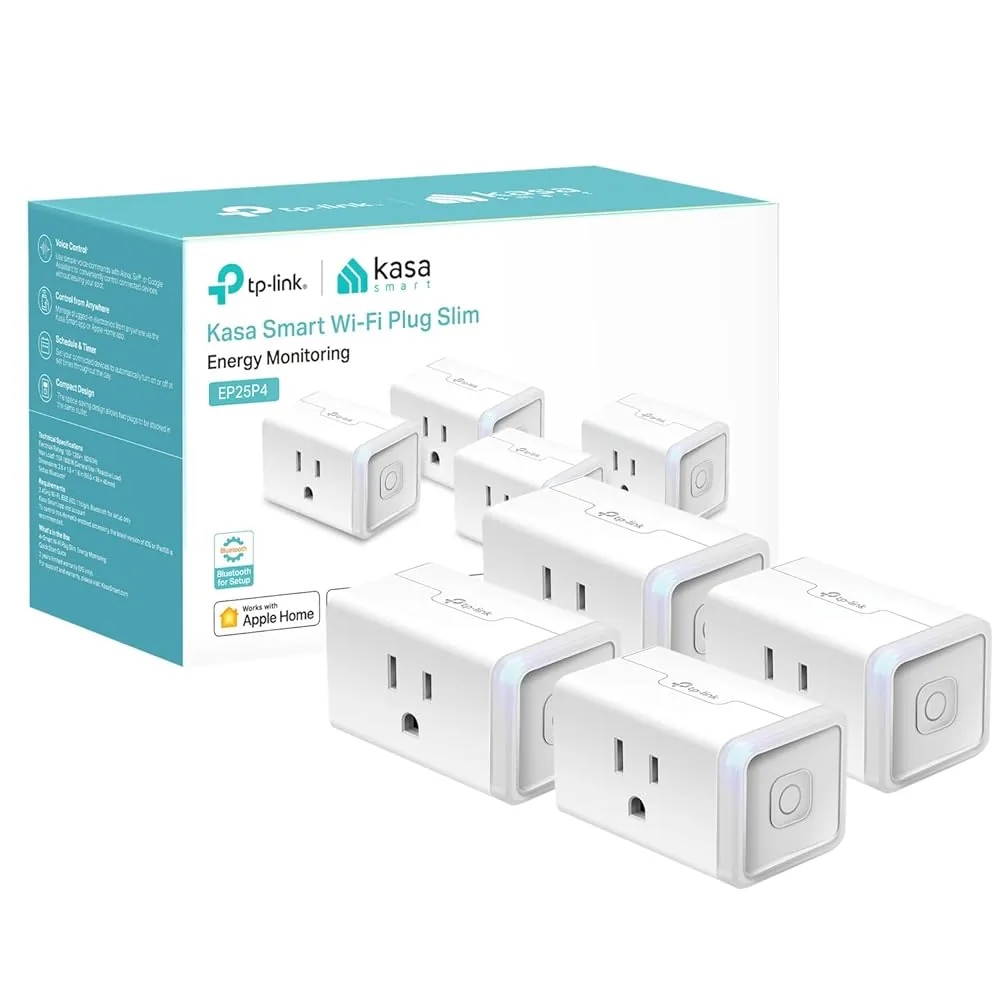
Kasa EP25 Smart Plug with Energy Monitoring (4-pack)
HomeKit, Alexa and Google; real-time and 30-day energy history; 15 A.
View on Amazon2. Kasa KP125M: Best for Matter
The Matter-certified version, so it works with Apple Home, Alexa, Google Home and SmartThings from one setup. TP-Link lists the same 15 A / 1,800 W resistive rating. One catch from the datasheet: energy monitoring is not available in the Apple Home app, so you still open the Kasa app to see the watts.
We may earn a commission if you buy through these links, at no extra cost to you. Products are chosen on published specifications; we do not test them in-house (how we choose).
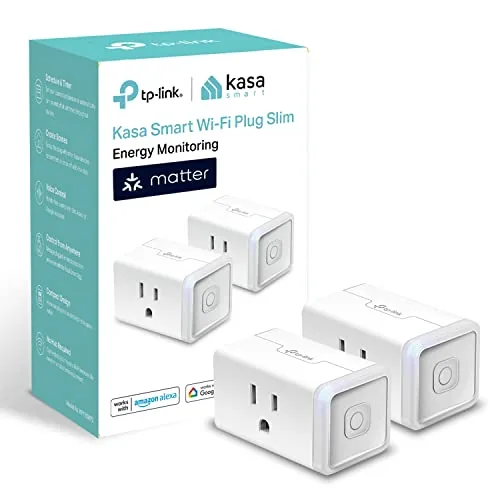
Kasa KP125M Matter Smart Plug with Energy Monitoring (2-pack)
Matter-certified; energy data in the Kasa app; 15 A / 1,800 W.
View on Amazon3. Emporia Smart Plug: Best With a Vue Panel Monitor
Emporia’s plug reports per-device energy use in the same app as the Emporia Vue panel monitor, so plug-level and circuit-level data sit side by side. It also works on its own, and Emporia says all app features, scheduling and cloud storage come with no subscription. Its continuous rating is lower than the Kasa plugs: 15 A peak but 10 A continuous, and Emporia warns that space heaters and portable air conditioners often exceed its limits.
We may earn a commission if you buy through these links, at no extra cost to you. Products are chosen on published specifications; we do not test them in-house (how we choose).
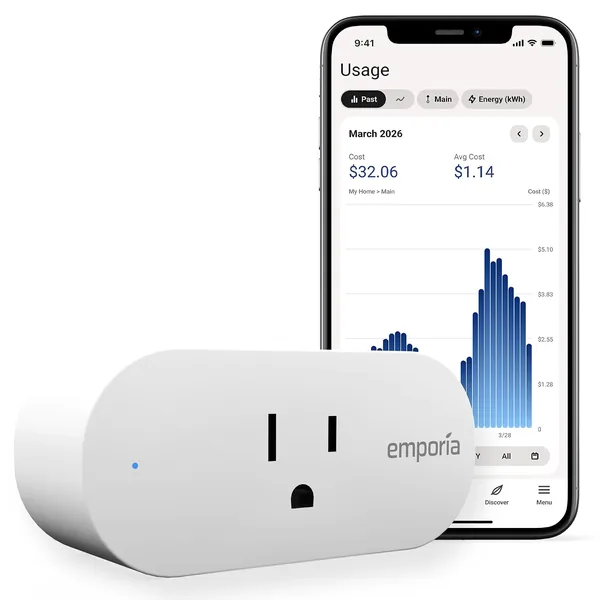
Emporia Energy Monitoring Smart Plug
Per-device energy tracking in the Emporia app; works with Alexa and Google; no subscription.
View on AmazonWhat to Plug In First
- The TV stack: TV, soundbar, streaming box, game console, cable box. Electronics were about half of the idle load NRDC measured.
- The home office: desktop tower, monitors, printer, speakers.
- Anything with a clock, glowing light or warm power brick that runs all day.
Do not use a smart plug for refrigerators and freezers, sump pumps, medical equipment, or space heaters (most heater manuals say to plug directly into a wall outlet, and heaters can exceed a plug’s continuous rating). Check the plug’s load rating against the device’s label either way.
A good routine: move one plug through three suspect areas over three nights, note the standby watts, then leave it on the worst offender. For a whole shelf of devices, a smart power strip is cheaper per outlet. For hardwired loads such as HVAC, the water heater or an EV charger, you need a panel energy monitor.
Free: Home Energy Audit Checklist (PDF)
A two-page, room-by-room checklist for finding air leaks, standby power and heating and cooling waste yourself, in the order that pays back fastest. Get it now, plus new fix guides by email. Unsubscribe any time.
By signing up you agree to receive emails from EcoHome Intelligence. See our Privacy Policy.
Frequently Asked Questions
Can a smart plug lower my electric bill?
Yes, on devices that draw power while idle. Multiply the standby watts the plug shows by 8.76 to get kWh per year, then by your rate, and schedule the plug off when you do not need the device. It saves nothing on devices that are already off at the wall.
What is the best smart plug with energy monitoring?
The Kasa EP25 if you use Apple HomeKit, the Kasa KP125M if you want Matter, and the Emporia Smart Plug if you already own an Emporia Vue panel monitor.
Does the Kasa KP125M show energy use in Apple Home?
No. TP-Link notes that energy monitoring is not available in the Apple Home app; you view it in the Kasa app.
Can I put a space heater on a smart plug?
It is not recommended. Most heater manuals say to plug directly into a wall outlet, and Emporia says space heaters often exceed its plug’s 10 A continuous rating.
Do energy-monitoring smart plugs need a subscription?
None of our three picks does. Emporia says all features and cloud storage are included, and the Kasa energy history is in the free Kasa app.
Related Guides
- What is vampire power? — where standby waste comes from
- Best smart power strip — for a whole shelf of devices
- Best home energy monitors — whole-home, circuit by circuit
