EcoGuide · Heat Pumps · Updated 2026-09-28 · 1,400 words
Best Thermostat for a Heat Pump With Auxiliary Heat
The Short Answer
On a heat pump with electric backup strips, the feature that matters most is an outdoor-temperature lockout for auxiliary heat: a setting that stops the strips from running when it is mild enough outside for the heat pump to cope on its own. Google’s own help page puts auxiliary heat at about 2 to 5 times the cost of running the heat pump.
| Pick | Best for | Aux-heat control (documented) |
|---|---|---|
| ecobee Smart Thermostat Premium | Most ducted heat pumps | “Aux Heat Max Outdoor Temperature” and “Compressor Min Outdoor Temperature” thresholds |
| Google Nest Learning Thermostat (4th gen) | Set-and-forget households | Heat Pump Balance, or a manual aux lockout temperature |
| Honeywell T10 Pro / Lyric T6 Pro | Contractor installs | Aux and compressor lockouts in the installer menu |
| Mysa for Mini-Splits | Ductless mini-splits | Not applicable: mini-splits are controlled by infrared, with no aux strips to lock out |
How these were chosen: we compared published manufacturer specifications and the Bonneville Power Administration’s thermostat support sheets, which list the exact lockout settings on each model. We do not run our own heat pump trials.
Why Auxiliary Heat Lockout Is the Feature to Buy For
A heat pump moves heat rather than making it. The backup (“auxiliary”) heat on most ducted systems is electric resistance strips, which make heat directly and cost far more per hour. The thermostat decides when to call for them.
Without a lockout, many thermostats bring on the strips whenever the house falls a couple of degrees behind the setpoint — after a setback, say, or when you nudge the temperature up — even on a day when the heat pump alone would have caught up. A lockout adds a simple rule: above a chosen outdoor temperature, the strips stay off.
Two related settings are worth knowing:
- Aux heat lockout (ecobee: “Aux Heat Max Outdoor Temperature”). Above this outdoor temperature, auxiliary heat will not run.
- Compressor lockout (ecobee: “Compressor Min Outdoor Temperature”). Below this outdoor temperature, the heat pump itself is switched off. Set too high, it forces the house onto strip heat. Cold-climate heat pumps can usually run much lower than older units — check your heat pump’s documentation.
If you are not sure what your thermostat is doing today, read emergency heat vs auxiliary heat first, then why aux heat won’t turn off.
1. ecobee Smart Thermostat Premium: Best Overall
ecobee exposes both lockouts directly in Settings → Installation Settings → Thresholds, which is why it is the easiest recommendation for a ducted heat pump. BPA’s support sheets list the same two settings across the ecobee3 lite, 4, 5, Enhanced and Premium.
- Compatibility (ecobee spec): heat pumps up to 2 heat / 2 cool plus 2 stages of aux heat; conventional 2H/2C; boilers.
- In the box: one SmartSensor for a second room, and a Power Extender Kit for homes without a C wire.
- Worth knowing: it is the most expensive pick here. The cheaper ecobee Essential is newer than BPA’s June 2023 sheet, so confirm its threshold settings before buying it for a heat pump.
We may earn a commission if you buy through these links, at no extra cost to you. Products are chosen on published specifications; we do not test them in-house (how we choose).
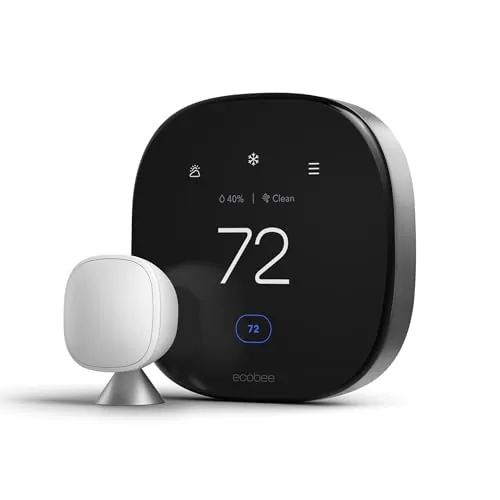
ecobee Smart Thermostat Premium
Aux Heat Max Outdoor Temperature and Compressor Min Outdoor Temperature settings; SmartSensor and Power Extender Kit included.
View on Amazon2. Google Nest Learning Thermostat (4th gen): Best Hands-Off Option
Nest handles aux heat with Heat Pump Balance. Max Comfort (the default) uses aux heat readily; Balanced and Max Savings push the lockout temperature progressively lower; turning it Off lets you set the lockout temperature yourself in the equipment settings.
- Compatibility (Google spec): heat pumps up to 3 stages with 1 or 2 stages of auxiliary and emergency heat (O/B, AUX, AUX2, E).
- Power: Google says it works without a C wire in most homes, and that in limited cases (under 1%) a C wire or Nest Power Connector is needed.
- Worth knowing: the default is Max Comfort. If you buy a Nest for a heat pump, change that setting on day one. The Amazon listing below bundles a Nest Temperature Sensor.
We may earn a commission if you buy through these links, at no extra cost to you. Products are chosen on published specifications; we do not test them in-house (how we choose).
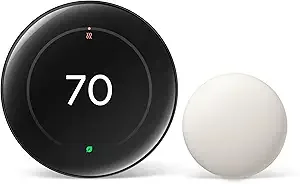
Google Nest Learning Thermostat (4th gen)
Heat Pump Balance or a manual aux lockout; this listing includes a Nest Temperature Sensor.
View on Amazon3. Honeywell T10 Pro or Lyric T6 Pro: If a Contractor Is Installing
Honeywell’s professional models document both lockouts. BPA lists the T10 Pro’s under “Equipment Lockouts” (installer setting 3120) and the Lyric T6 Pro’s as “Aux Heat Lock Out” (ISU 356) and “Balance Point” (ISU 355), using either a wired outdoor sensor or Wi-Fi weather data.
These are usually sold and set up through HVAC contractors, so we do not link a retail listing. If your installer offers one, ask them to set the lockouts before they leave.
4. Mysa for Mini-Splits: For Ductless Systems
A ductless mini-split has no 24 V thermostat wiring and usually no strip heat, so none of the above applies. Mysa for Mini-Splits sits on the wall and controls the indoor unit by infrared, like the remote does. It plugs into an outlet and works with most units that have an IR remote with an LCD display — check Mysa’s compatibility list for your model first.
We may earn a commission if you buy through these links, at no extra cost to you. Products are chosen on published specifications; we do not test them in-house (how we choose).
Mysa Smart Thermostat for Mini-Splits
Wall-mounted infrared controller for ductless heat pumps; plugs into an outlet, no wiring.
View on AmazonBudget Thermostats: Check Before You Buy
Cheaper smart thermostats — the Amazon Smart Thermostat, Honeywell Home T5 and T9, Wyze — can drive a heat pump, but none of them appears in BPA’s list of models with documented lockout settings. That does not prove a model lacks one; it means you should find the setting in its manual before you buy it for a heat pump with electric backup.
On a gas furnace or a heat pump without strips, this matters much less, and a budget model is a reasonable choice: see the best smart thermostats under $100.
Before You Install: Five Things to Confirm
- Your system type: heat pump with electric strips, dual fuel (heat pump plus gas furnace), or ductless.
- Your wiring: photograph the old thermostat’s terminals. Heat pumps use an O or B reversing-valve wire; aux heat is usually W1/AUX; emergency heat is E.
- Whether you have a C wire. The ecobee includes a Power Extender Kit; Nest rarely needs one.
- Your heat pump’s documented low-temperature limit, before you set the compressor lockout.
- Your utility’s thermostat rebate. Many utilities run their own programmes, so check your utility’s website rather than assuming one applies.
Free: Home Energy Audit Checklist (PDF)
A two-page, room-by-room checklist for finding air leaks, standby power and heating and cooling waste yourself, in the order that pays back fastest. Get it now, plus new fix guides by email. Unsubscribe any time.
By signing up you agree to receive emails from EcoHome Intelligence. See our Privacy Policy.
Frequently Asked Questions
What is aux heat lockout?
A setting that stops auxiliary (backup) heat from running when the outdoor temperature is above a threshold you choose, so the cheaper heat pump carries the load on mild days.
Do all smart thermostats work with heat pumps?
Most can switch a heat pump on and off, but not all document an outdoor-temperature lockout for auxiliary heat. That setting is what separates a good heat pump thermostat from an adequate one.
Can I use a Nest thermostat with a heat pump?
Yes. The Nest Learning Thermostat (4th gen) supports heat pumps with up to 3 stages and 1 or 2 stages of auxiliary and emergency heat. Change Heat Pump Balance from its Max Comfort default if you want aux heat used less.
Is ecobee or Nest better for a heat pump?
ecobee gives you direct numeric control of both the aux heat and compressor lockouts. Nest automates the choice through Heat Pump Balance, with a manual lockout available if you turn that off. Choose ecobee for control, Nest for simplicity.
What thermostat should I use for a mini-split?
A mini-split usually has no 24 V thermostat wiring. Use an infrared controller such as Mysa for Mini-Splits, which replaces the handheld remote.
Related Guides
- Emergency heat vs auxiliary heat — what each mode does and which one you choose
- Aux heat won’t turn off? — start with the outdoor unit
- Nest aux heat running too much — the Heat Pump Balance fix in detail
- Heat pump bill spiked after a new thermostat? — why it happens
