EcoGuide · Heat Pumps · Updated 2026-10-02 · 1,400 words
Emergency Heat vs Auxiliary Heat: What “EM Heat” Actually Does
The Short Version
They are not two names for the same thing. Auxiliary heat is automatic: Carrier says it runs alongside your heat pump to boost heating power, and the thermostat decides when. Emergency heat is a setting you choose: Lennox says it completely shuts off the heat pump and runs only off the backup source.
| Auxiliary heat | Emergency heat | |
|---|---|---|
| Who turns it on | The thermostat, automatically | You, manually |
| Heat pump | Still running (on most all-electric systems) | Locked out |
| Heat source | Heat pump plus backup | Backup only |
| When it is right | Very cold weather, defrost, a large temperature increase | The heat pump has failed |
The expensive mistake runs one way: switching to EM heat in the first cold snap because it sounds like “more heat”, and leaving it there.
Why the Mix-Up Costs Money
The backup source, Lennox explains, is for most homes electric resistance heating, similar to how a space heater or toaster works; some dual-fuel systems use a gas or oil furnace instead. Resistance heat turns each unit of electricity into one unit of heat. A heat pump moves heat instead of making it, which is why the Department of Energy says it can deliver up to three times more heat energy to a home than the electrical energy it consumes.
How much that is worth depends on climate and rates. One figure the Department of Energy cites: a Northeast Energy Efficiency Partnerships study found that cold-climate heat pumps installed in the Northeast and Mid-Atlantic saved around 3,000 kWh (or $459) a year compared with electric resistance heaters. Running on EM heat all season gives that back.
It goes unnoticed because the house stays warm. Nothing feels broken; the only sign is the bill.
When You Should Use Emergency Heat
The manufacturers agree it is for a heat pump that cannot run. Honeywell describes the EM HT setting as one that locks out the heat pump compressor so that only backup heat is used, typically until a contractor can fix the heat pump. Carrier: only switch to it if the heat pump has physically broken down or malfunctioned. Lennox lists three cases:
- Your HVAC technician tells you to turn it on while you wait for a repair or a part.
- The heat pump has completely failed and you need temporary heat.
- The outdoor unit is frozen solid or damaged.
Cold weather alone is not on that list. Goodman says that as long as you are comfortable, there is no need to manually switch on the auxiliary or emergency heat when it is below freezing; the system brings in auxiliary heat by itself. Google words it more loosely for Nest, saying emergency heat is typically needed only in very cold weather, but adds that if you need it often the heat pump may not be working as it should and a technician should test it.
How to Tell Which One Is Running
- Honeywell: the display shows “Aux Heat On” when auxiliary heat is running. In the Em Heat position, Honeywell says the compressor does not run, only the Emergency heat runs.
- Nest: emergency heat is off unless you turn it on. On the Nest Thermostat (4th gen) it is under Settings → Emergency Heat; on older models under Settings → Equipment. Google says it must be turned on manually, while the thermostat uses auxiliary heat automatically.
- Any thermostat: if you switched to EM heat during a cold spell at some point, check the mode now. Nothing else will remind you.
The More Common Problem: Aux Heat Running When It Should Not
Most people who think they have an emergency heat problem have an auxiliary heat problem. Aux heat in very cold weather is expected. Trane says it is only a bad thing if it comes on and stays on when temperatures are above 40 degrees. Carrier lists what that can mean: a dirty air filter, a refrigerant leak, a malfunctioning sensor, or that the thermostat was raised too quickly.
That last one is the cheap fix. Two habits and one setting matter:
- Raise the temperature gradually. A big jump at the thermostat can call in the backup heat even in mild weather.
- Skip deep setbacks. The Department of Energy says do not set back the heat pump’s thermostat if it causes the backup heating to come on. ENERGY STAR adds that heat pumps do not save energy by being turned down when you are away or asleep.
- Use the thermostat’s aux heat limit. On Nest it is Heat Pump Balance, or an aux lockout temperature you set if Heat Pump Balance is off. On ecobee it is the Aux Heat Max Outdoor Temperature threshold. Ask your installer what value suits your system before changing it.
Step-by-step settings: Nest or ecobee aux heat running too much. If it never switches off: auxiliary heat will not turn off.
Thermostats With an Aux Heat Limit
If your current thermostat cannot limit auxiliary heat, these two can.
We may earn a commission if you buy through these links, at no extra cost to you. Products are chosen on published specifications; we do not test them in-house (how we choose).
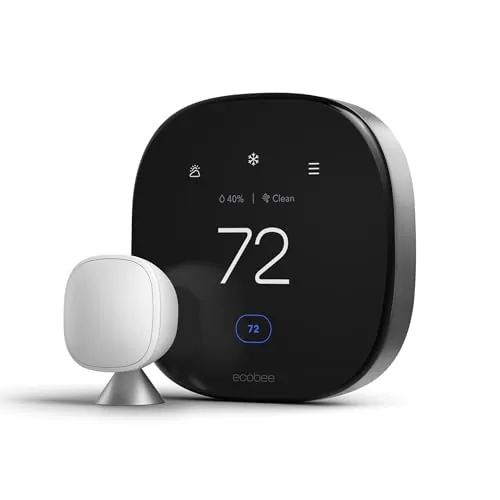
ecobee Smart Thermostat Premium
ecobee thermostats have an Aux Heat Max Outdoor Temperature threshold: the auxiliary heat will not run above it.
View on Amazon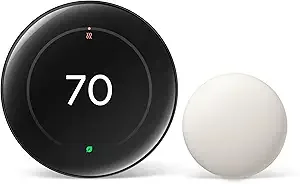
Google Nest Learning Thermostat (4th Gen)
Heat Pump Balance decides how much auxiliary heat to use; it needs Wi-Fi to work.
View on AmazonWhen to Call a Technician
- You have had to switch to emergency heat. It is a stopgap until the heat pump is repaired, so book the repair.
- Aux heat comes on and stays on when it is above about 40°F outside.
- You need emergency or auxiliary heat regularly to stay comfortable.
- The Department of Energy also recommends a professional service at least once a year.
Free: Home Energy Audit Checklist (PDF)
A two-page, room-by-room checklist for finding air leaks, standby power and heating and cooling waste yourself, in the order that pays back fastest. Get it now, plus new fix guides by email. Unsubscribe any time.
By signing up you agree to receive emails from EcoHome Intelligence. See our Privacy Policy.
Frequently Asked Questions
What is the difference between emergency heat and auxiliary heat?
Auxiliary heat comes on automatically to help the heat pump. Emergency heat is switched on manually; it shuts the heat pump off and heats with the backup source only.
Should I use emergency heat when it is very cold?
Generally no. Manufacturers say emergency heat is for a heat pump that has failed, and that the system brings in auxiliary heat by itself in cold weather. If you find you need it often, have the heat pump checked.
Is emergency heat more expensive?
Yes when the backup is electric resistance heat. The Department of Energy says backup heating systems such as electric strip heaters are usually more expensive to operate because they are less efficient.
Why is my aux heat on when it is not that cold?
Trane and Carrier both treat aux heat above about 40°F as a sign of a problem. Carrier lists a dirty air filter, a refrigerant leak, a faulty sensor, or raising the thermostat too quickly.
How do I turn off emergency heat?
Set the thermostat mode back to Heat. On a Nest, emergency heat is a switch under Settings (Emergency Heat, or Equipment on older models).
Related Guides
- Auxiliary heat will not turn off — when it is stuck on
- Nest or ecobee aux heat running too much — the exact settings
- Heat pump blowing cold air — why the air feels cool
- Heat pump runs constantly in winter — when long run times are normal
Sources
- Carrier: What is auxiliary heat?
- Lennox: What is emergency heat and when to use it?
- Trane: What is auxiliary heat in a heat pump system?
- Goodman: Heat pump common questions and answers
- Honeywell Home support: What is the EM HT switch?
- Honeywell Home support: Aux Ht versus Em Ht
- Google Nest Help: Emergency Heat for heat pump systems
- Google Nest Help: Heat Pump Balance
- ecobee Smart Thermostat Enhanced user guide (PDF)
- U.S. Department of Energy: Air-source heat pumps
- U.S. Department of Energy: Operating and maintaining your heat pump
- ENERGY STAR: Air-source heat pumps
