Last Updated: 2026-10-01
Refoss vs Emporia Vue vs Sense: Which Energy Monitor to Buy
For a baseline before any project, see our guide to the best home energy monitors.
Update, September 2026: Sense says it stopped selling in-panel home monitors on December 31, 2025, with support continuing for existing owners, and its Amazon listing now shows as unavailable. If you are buying today, the real choice is Emporia Vue 3 vs Refoss, which is what the rest of this page compares. The Sense section is kept for people who already own one.
The Short Answer
| If you… | Buy | Why |
|---|---|---|
| Run Home Assistant, or want it to work without the cloud | Refoss EM16P View on Amazon | Native local control, open API and MQTT; 60 A branch clamps |
| Want a polished app and no tinkering | Emporia Vue 3 View on Amazon | Wi-Fi or Ethernet; up to three 200 A mains sensors |
| Only need to check a few appliances | A smart plug energy monitor | No panel work, no electrician |
| Already own a Sense | Keep it | Sense says support continues; it is no longer sold new |
We may earn a commission if you buy through these links, at no extra cost to you. Products are chosen on published specifications; we do not test them in-house (how we choose).
Most people arriving here are really deciding between the Refoss EM16 and the Emporia Vue 3 — two 16-circuit panel monitors at similar money — and wondering whether Sense, which works completely differently, is the smarter buy. Short version: the Refoss/Emporia choice comes down to how much you care about local control, and Sense is a different product answering a different question.
How We Compared These
We do not run our own accuracy bench, so the figures below are the manufacturers’ published specifications rather than our measurements, each linked to the page it came from. What we compare is what actually decides which one suits your panel: whether you get per-circuit visibility, how many circuits and at what amperage, whether the thing keeps working when the vendor’s cloud does not, and whether you will need an electrician to fit it.
That last set matters more than a decimal place of accuracy. Sense infers devices from the aggregate signal using machine learning — there is no per-circuit wiring, so you see recognised devices, not circuits. Emporia and Refoss clamp individual branch circuits, so you see exactly which circuit is drawing what, but they will never tell you that the mystery 40 W is a specific set-top box. Those are different products for different questions.
Published Specifications
| Monitor | Per-circuit | Sensors | Works without cloud | Certification |
|---|---|---|---|---|
| Sense | No | 2 mains CTs only; ML on the aggregate signal | No — detection is cloud-side | — |
| Emporia Vue 3 | Yes — up to 16 | Up to 3 × 200 A mains, 16 × 50 A branch; Wi-Fi 2.4 GHz or Ethernet | Not out of the box (ESPHome reflash is a community project) | UL 61010, UL 2808, CE, UKCA, FCC |
| Refoss EM16 / EM16P | Yes — up to 16 (EM16P up to 18) | 2 × 200 A mains, 16 × 60 A branch | Yes — open API and MQTT, native Home Assistant, no flashing | ETL, to the UL 61010 standard |
Sources: Emporia, Refoss EM16 and EM16P product pages, checked September 2026. We deliberately do not print prices here: all three move constantly and a stale number is worse than none. Use the links to check what each costs today.
Refoss EM16 vs Emporia Vue 3: The Head-to-Head
On paper these two look almost interchangeable — both clamp 16 branch circuits, both have a free app, both sit in the same price bracket. Four things actually separate them.
1. Local control — the decisive difference
Refoss publishes an open API and MQTT and states the EM16P supports Home Assistant natively, with no firmware flashing and no loss of warranty. The device can run without the cloud.
Emporia’s Vue 3 talks to Emporia’s cloud by default. There is a well-established community project to reflash it with ESPHome for local polling, and plenty of people run it that way happily — but that is an unofficial route that means opening the device and accepting the warranty consequences. If you want local data and you do not want a soldering-adjacent afternoon, that is a straightforward point to Refoss.
If you have never heard of Home Assistant and have no plans to, this difference is worth nothing to you. Skip to the next point.
2. What happens when the cloud has a bad day
This is the same difference stated as a risk rather than a feature. A cloud-dependent monitor stops giving you data when the vendor’s service is down, when your internet is out, and permanently if the company ever shuts the service off. A monitor with a local API keeps logging to your own system regardless. Neither vendor is unusually unreliable; the point is which failure modes you are signing up for on a device that is going to be screwed into your panel for a decade.
3. Clamp ratings and panel fit
Refoss ships 60 A branch clamps against Emporia’s 50 A. For ordinary 15–20 A lighting and receptacle circuits that is irrelevant. It starts to matter if you want to clamp a 240 V EV charger, a heat pump or a range circuit directly — check the breaker rating against the clamp rating before you buy either one.
On the mains side Emporia supports up to three 200 A mains CTs, so it can cover a three-phase or a multi-service setup that the two-mains Refoss cannot. Refoss lists compatibility with single-phase two-wire, split-phase three-wire and three-phase four-wire Wye systems, and explicitly excludes Delta systems. Almost every US home is split-phase 240 V and fine with either.
4. Certification — check it, do not assume it
Anything living inside your service panel should carry a recognised safety listing, and some electricians will refuse to install a device that does not. Emporia lists UL 61010 and UL 2808; Refoss lists ETL certification to the UL 61010 standard. ETL and UL are both OSHA-recognised testing laboratories, so an ETL mark is not a lesser thing than a UL mark — but “compliant with” and “listed by” are not the same claim, so if your electrician asks, show them the mark on the actual unit rather than a spec sheet.
EM16 or EM16P? Which Refoss
Refoss sells two closely related units and the listings are easy to confuse. The EM16 is the original: two 200 A mains CTs plus sixteen 60 A branch CTs, Home Assistant compatibility via a firmware update with local LAN discovery. The EM16P is the newer one: up to 18 circuits, native Home Assistant with no flashing, open API and MQTT, and a published accuracy figure of ±2%.
If local integration is why you are buying Refoss at all, the EM16P is the one to get — that is precisely what it is for. If you only ever intend to use the Refoss app, the EM16 does the same monitoring job.
Where Sense Fits — and Where It Does Not
Sense is not a cheaper or dearer version of the other two. It clamps only your mains and then uses machine learning to pick individual appliances out of the combined waveform. When it works, it answers a question no clamp-based monitor can: what is that thing. When it does not, you get a list of unnamed “Motor 1” and “Heat 3” devices and a long wait.
Device recognition is probabilistic and improves over weeks to months. Manufacturers do not publish a per-device accuracy figure, and you should be suspicious of any review that quotes one as though it were a specification — it depends entirely on which appliances you own and how distinctive their signatures are. Sense does confirm there is no subscription fee to use the app.
Practical read: if your question is “which circuit is costing me money”, buy a clamp-based monitor, because it answers that on day one with certainty. If your question is “something in this house draws power all night and I cannot find it”, Sense is built for that — though a smart plug energy monitor and an hour of patience often finds the same culprit for a fraction of the money.
Installation: Budget for the Electrician
All three require working inside a live service panel. This is not a beginner DIY job: the main lugs remain energised with the breaker off, and getting it wrong is a fatal-category mistake rather than an expensive one. Get a quote from a licensed electrician before you order: the price depends mostly on how crowded the panel is and whether the CT leads have somewhere sensible to run.
Two things worth checking before you order: whether there is physical room in the panel for sixteen clamps and their leads, and whether the monitor needs its own breaker slot for power.
If the panel work is the sticking point, a plug-level monitor requires no electrician at all and will tell you plenty about individual appliances — just not about hardwired loads like your HVAC, water heater or oven, which is usually where the money actually goes.
Which One Should You Buy?
Buy the Refoss EM16P if: you run Home Assistant, or you want your energy data to keep working independently of any vendor’s cloud. Native local integration without flashing is the thing you are paying for, and nothing else in this bracket offers it out of the box.
We may earn a commission if you buy through these links, at no extra cost to you. Products are chosen on published specifications; we do not test them in-house (how we choose).
Refoss Smart Home Energy Monitor (16 circuit sensors)
Panel monitor with local control: native Home Assistant, open API and MQTT, and it keeps working without the cloud.
View on AmazonBuy the Emporia Vue 3 if: you want a polished phone app and no tinkering, or you need more than two mains CTs for a three-phase or multi-service panel. Ethernet as well as Wi-Fi is a genuine advantage if your panel sits in a basement corner where Wi-Fi is poor — which is most basements.
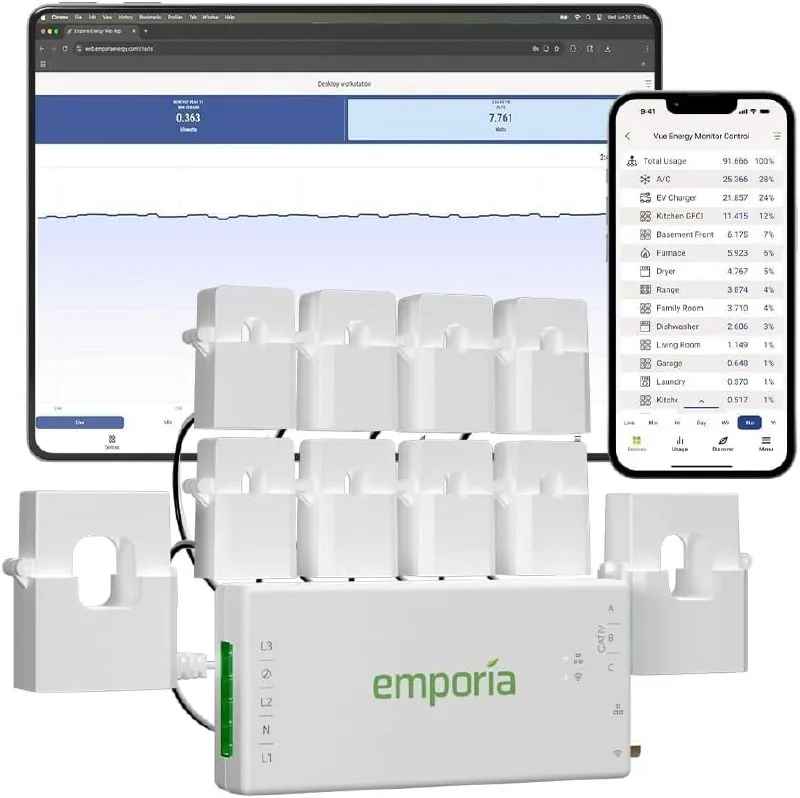
Emporia Vue 3 Energy Monitor
Installs in the electrical panel; with its circuit sensors it tracks usage breaker by breaker.
View on AmazonIf you already own a Sense: keep using it. Sense says support continues for existing owners, but it no longer sells in-panel monitors, so it is not a buying option today.
Buy none of them yet if: you have not established that you have a problem worth the price of a monitor and an electrician. Start with our free energy audit checklist — for a lot of households the answer turns out to be insulation or an old water heater, and no monitor will change that.
Free: Home Energy Audit Checklist (PDF)
A two-page, room-by-room checklist for finding air leaks, standby power and heating and cooling waste yourself, in the order that pays back fastest. Get it now, plus new fix guides by email. Unsubscribe any time.
By signing up you agree to receive emails from EcoHome Intelligence. See our Privacy Policy.
Frequently Asked Questions
Refoss or Emporia: which is better?
For local control and Home Assistant, Refoss: the EM16P supports it natively without flashing, and publishes an open API and MQTT. For app polish, Ethernet and three-phase or multi-service panels, Emporia. On the core job of showing 16 circuits in real time, they do the same thing.
Does the Emporia Vue 3 work with Home Assistant?
Not natively. There is an active community ESPHome project that reflashes the device for local polling, but it is unofficial and involves opening the unit. Refoss publishes native Home Assistant support instead.
Can I still buy a Sense energy monitor?
Not new. Sense says it stopped selling in-panel home monitors on December 31, 2025, with support continuing for existing owners, and its Amazon listing shows as unavailable.
Do these energy monitors require a subscription?
No. Emporia and Refoss both ship a free app, and Sense states that it charges no fee to use its app.
Can I clamp an EV charger or heat pump circuit?
Check the breaker rating against the clamp rating first. Refoss branch clamps are rated 60 A and Emporia’s 50 A, so a 60 A EV charger circuit is outside the Emporia branch clamp’s rating.
Do I need an electrician to install these monitors?
Plan on one. Both install inside the electrical panel, where the main lugs stay energised even with the main breaker off. Get a quote before you order.
Will a home energy monitor lower my bill?
Only indirectly. ACEEE’s review of nine real-time feedback pilots (Foster & Mazur-Stommen, 2012) found household electricity savings from 0% to 19.5%, averaging 3.8%. A monitor shows where the waste is; the saving comes from what you change.
Related Guides
- Best Home Energy Monitors — the monitors you can still buy
- Best Smart Plug Energy Monitor — per-outlet monitoring, no electrician
- Find Phantom Loads in 4 Minutes — How to use these monitors to find energy waste
- Why Is My Electric Bill Increasing? — Diagnose a rising bill
Sources
- Emporia: Vue 3 product page
- Refoss: EM16P product page
- Refoss: EM16 product page
- Sense: end of in-panel monitor sales
- ACEEE: real-time feedback pilots (2012)
Affiliate Disclosure: EcoHome Intelligence participates in the Amazon Associates Program. Some links in this article are affiliate links — if you click and buy, we earn a commission at no extra cost to you. We only recommend products we have researched against published specifications, manufacturer documentation and owner reports. How we choose products.
